

Inaugural Meeting of the Zagros Universities Consortium Held with the Presence of the Representative of Lorestan University
 Nov 01, 2026
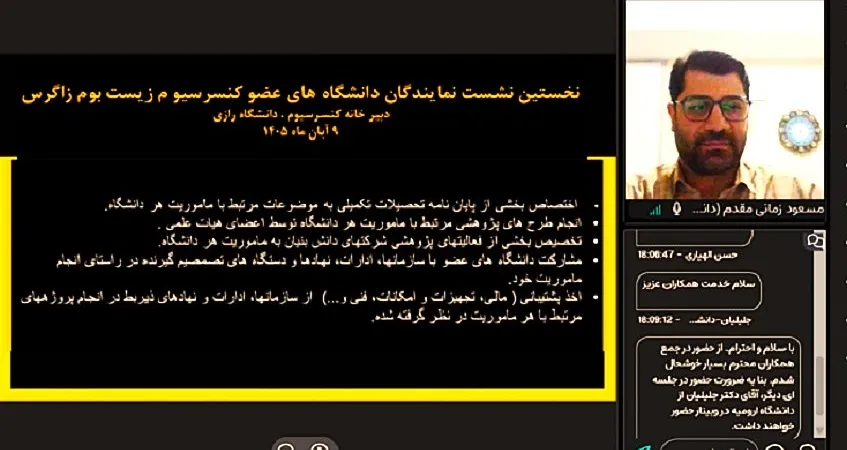
On Saturday, November 9, 2024, the first meeting of the representatives of the Zagros Universities Consortium was held online (virtually) with the participation of the representative of Lorestan University.
According to the Public Relations of Lorestan University, Dr. Jamal Fatollahhi (President of Razi University of Kermanshah) and representatives of the consortium member universities were present at this meeting. The secretariat of the consortium is located at Razi University of Kermanshah.
The Zagros Universities Consortium has been formed with the overarching goal of creating scientific and cross-sectoral integration for the revival of the strategic Zagros ecosystem, with the participation of universities including Razi University of Kermanshah, Lorestan University, Ilam University, Shiraz University, Shahid Chamran University of Ahvaz, Yasuj University, University of Kurdistan, University of Urmia, Malayer University, and Persian Gulf University of Bushehr. This aims to directly link the region's university capacities to the country's policymaking, decision-making, and implementation processes by reducing institutional parallelism and isolated approaches.
Through data-driven monitoring of the ecosystem's status, scientific crisis management, conservation and restoration of natural resources and biodiversity, as well as empowerment and strengthening the social and livelihood resilience of local communities, this consortium strives to provide the necessary scientific authority for the intergenerational preservation of this civilizational expanse and to ensure the sustainability and ecological security of the country.
At this meeting, Dr. Masoud Zamanimoghadam, a faculty member of the Faculty of Literature and Human Sciences at Lorestan University and the university's representative in the Zagros Universities Consortium, while expressing Lorestan University's readiness for structured, joint, and effective collaborations within this consortium, stated: "If we view the Iranian plateau from a sociological and climatic perspective, we realize that Iran's cultural climates are intertwined and all find meaning under the single umbrella of Iran's cultural climate. In this regard, provinces and regions located in the Zagros expanse, despite their specific characteristics, share similarities due to deep historical, cultural, ecological, and social commonalities."
Dr. Zamanimoghadam explained: "This structural connectivity serves as a basis for synergy among the region's universities to activate existing capacities for the cultural, political, social, and economic development of this region. This development must be achieved with a scientific, eco-centric, problem-solving, and long-term perspective. The Zagros is one of the most fundamental components of Iranian civilization, the ecosystem of the Iranian plateau, the backbone of the country's climatic and water stability, and indeed, a historical defender of our beloved Iran."
He continued: "However, today, this strategic ecosystem faces critical challenges such as environmental issues, water crisis and soil erosion, climate change, social and cultural problems, and challenges in the resilience of local communities. The preservation of the Zagros is a national, civilizational, and intergenerational necessity, and in this path, universities, as the most important scientific institutions of society, must, within the framework of their social responsibility, minimize the gap between academic knowledge and macro and local policymaking."
The faculty member of the Faculty of Literature and Human Sciences at Lorestan University added: "As the main university in the province, with the support of 434 faculty members, nearly 11,000 students, 8 faculties, and 218 active academic fields, it possesses significant capacities that can be utilized to fulfill the core missions of this consortium. Alongside specialized human capital, Lorestan University publishes a collection of specialized scientific and research journals that have provided an institutional platform for advancing the goals of this cross-sectoral scientific network:
_ The journals 'Zagros Archaeological Research' and 'Zagros Folklore Studies' (for the recreation and preservation of cultural identity and heritage).
_ The journal 'Heroic Literature' (considering the epic and deep-rooted characteristics of the Zagros dwellers).
_ The journals 'Environmental Foresight and Sustainable Development', 'Soil-Life', 'Plant Genetics Research', 'Physiology and Biochemistry of Plants of Iran', and 'Applied Research in Water Engineering' (for sustainable management of ecological resources and confronting environmental hazards).
_ The journals 'New Research in Geographical Policy' and 'Geographical Studies of Mountainous Regions' (for scientific support of regional policymaking and strengthening the social and economic resilience of local communities).
Dr. Zamanimoghadam emphasized: "We hope that through the continuation of inter-university dialogue, applied research, and interdisciplinary approaches within the framework of this consortium, we can take a firm step towards resolving or mitigating the issues faced by the people of the Zagros region."