

Presence of the Vice-Chancellor for Student Affairs of Lorestan University at the Tablet Donation Ceremony for Visually Impaired Students with Disabilities
 Jul 29, 2026
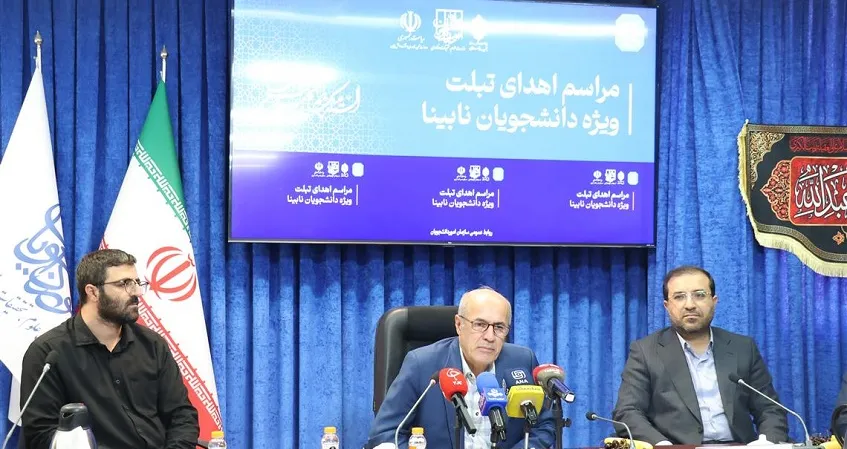
Dr. Mehdi Shahin, the Student Affairs Vice-Chancellor of Lorestan University, along with a group of chancellors and vice-chancellors from universities and higher education centers across the country, titled "Target Universities," attended the ceremony for the donation of special tablets for the visually impaired to students with disabilities; a ceremony held in the presence of Dr. Saeed Habiba, the Deputy Minister of Science and the Head of the Organization for Student Affairs.
According to the Public Relations of Lorestan University, quoting the Public Relations of the Organization for Student Affairs of the Ministry of Science, the ceremony for donating special tablets for the visually impaired to students with disabilities was held in the presence of Dr. Habiba, Deputy Minister of Science and Head of the Organization for Student Affairs, Dr. Abdul Hossein Bahrami, Head of the Operational Center for Knowledge-Based Economy Development Headquarters of the Vice Presidency for Science and Technology, Dr. Peyman Beigdeli, Acting Vice-Chancellor for Educational, Skill-Based, and Developmental Affairs of the Alavi Foundation, and the chancellors and representatives of the target universities, at the Organization for Student Affairs.
At this ceremony, the chancellors of Shahid Chamran University of Ahvaz, Kurdistan University, Ilam University, Hormozgan University, and the vice-chancellors of Lorestan University and Bu-Ali Sina University of Hamedan were present.
The Deputy Minister of Science and Head of the Organization for Student Affairs, emphasizing that disability should not be a barrier to acquiring knowledge and education, announced the development of a comprehensive regulation for supporting students with disabilities within the Organization for Student Affairs.
He stressed that this regulation, with operational plans such as creating a comprehensive database, continuous monitoring of implementation, and allocating special budgets for the adaptation of infrastructure, dormitories, and sports facilities, aims to remove physical and educational barriers and ensure educational justice in universities.
Dr. Habiba, at this ceremony, while referring to the importance of technology in achieving "digital educational justice," stated: "These special tablets for blind students function beyond a simple tool; they serve as a 'mobile classroom' and a 'portable library,' removing barriers to accessing scientific resources for blind, low-vision, and sighted students."
The Head of the Organization for Student Affairs, presenting statistics on the status of this group in the country, stated: "Currently, approximately 5,000 students with disabilities have been identified in the country, half of whom have visual impairments. The focus of these students is primarily on humanities and social sciences fields such as law and psychology."
He also mentioned the distribution of these students across various universities, including Payame Noor University (1,500 students), Ferdowsi University of Mashhad (500 students), and the University of Applied Science and Technology.
The Deputy Minister of Science, explaining the main axes of the regulation under approval, emphasized: "This document seeks to shift the perspective from 'pity' to 'duty-bound.' The axes of this regulation include: 1- Provision of physical and educational facilities: geometric modification of pathways, installation of guide signs, creation of ramps, adaptation of restrooms, and prioritization of ground-floor or elevator-equipped classrooms. 2- Psychological and social support: provision of free counseling services and strengthening psychological empowerment. 3- 'Student Helper' program: facilitating exam procedures, commuting, and access to libraries. 4- Welfare and financial services: prioritization in student loan disbursement, free supplementary insurance coverage, and adaptation of sports facilities."
The Head of the Organization for Student Affairs, referring to collaboration with philanthropists, urged universities to utilize public capacities for supporting students with disabilities by developing specific programs. He stated: "Many philanthropists, after directly observing the needs of these individuals, are prepared to support skill-based projects and career counseling. Furthermore, companies should participate in providing the necessary facilities for this group through their social responsibility.
Disability is a different ability
Dr. Habiba, in his speech, addressing the students, called them "valuable assets of Iran" and said: "With your iron will, you have proven that disability is not a limitation, but rather a different ability. We in the Organization for Student Affairs are obligated to exert all our efforts to remove the obstacles before you."
He pointed out that providing a favorable educational environment is a reflection of the implementation of educational justice in society and presented several key areas as essential solutions.
Maximum Utilization of New Technologies
He emphasized the necessity of facilitating students' daily affairs and highlighted the need to utilize assistive technology tools such as advanced Braille devices, touch tablets, and text-to-speech software, as well as the importance of providing smart hardware and stable internet access for students, especially in deprived regions.
Research-Oriented Approach and Awareness Raising for Managers
Dr. Habiba called for a thorough investigation of the educational, welfare, and social problems of blind students to take practical steps towards removing obstacles by raising awareness among university managers.
He also stressed the necessity of research into learning styles and individual characteristics of students to personalize education according to each student's needs.
Improving the Living Environment and Mental Health
Another area highlighted by Dr. Habiba was special attention to the condition of dormitories and adapting the students' living environment. He pointed to the significant role of university counseling and health centers and emphasized the need to enhance life skills and increase the adaptability of students with disabilities to educational environments.
Social Vitality and Flourishing of Talents
In the final part of his speech, Dr. Habiba emphasized the necessity of planning to foster vitality and joy among students with disabilities. He noted: "It is essential to identify the brilliant talents of these students and to utilize their capacities and capabilities in the best possible way by actively involving them in the cultural and artistic affairs of the university."