

Addition of a New Index in the Ranking of Iranian Universities: "Social Impact"
 Sep 28, 2026
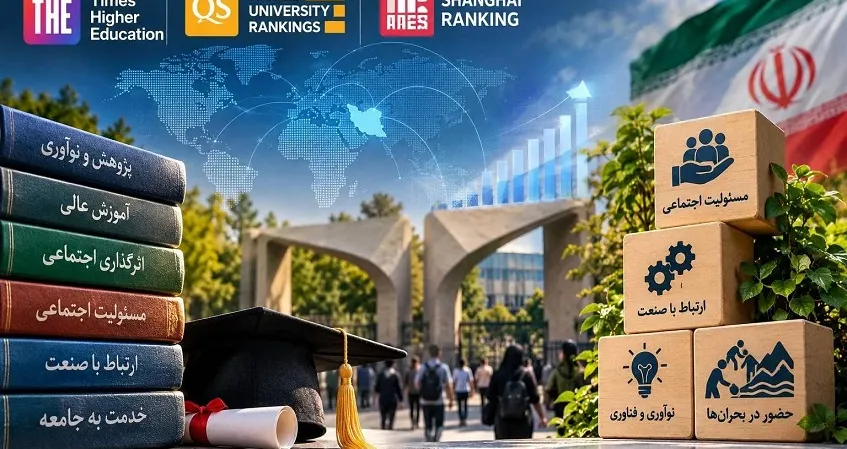
The Islamic World Science Citation and Monitoring Center (ISC) has this year added "Social Impact" and "Social Responsibility" to the national ranking indicators for Iranian universities; a change intended to incorporate universities' roles in solving societal issues, their connection with industry, and their presence during crises into their performance evaluations.
Dr. Mohammad Mehdi Alavianmehr, President of the Islamic World Science Citation and Monitoring Center, stated: "This institution has been conducting the national ranking of the country's universities since 2008 and announces its results annually. Currently, the information related to the new university rankings has been received and analyzed, and we anticipate the results of the latest university rankings to be published in September. Following the announcement of university results, the ranking of research institutes and non-governmental and non-profit higher education institutions will also be conducted. Alongside national rankings, ISC is also active in the field of international rankings and has a global ranking system, the results of which are usually announced by the end of the year."
Dr. Alavianmehr explained: "In the national ranking, we consider criteria and indicators that are more aligned with the country's science and technology culture, plans, and policies, as well as the approaches of the Ministry of Science and the Ministry of Health. One of the significant changes this year is the addition of 'Social Impact' and 'Social Responsibility' to the national ranking indicators. Accordingly, universities that have a greater presence and role in serving society and solving its problems will earn more points."
The President of the Islamic World Science Citation and Monitoring Center elaborated: "In this regard, we examine the extent to which universities have engaged in addressing various crises and societal issues. For instance, during wars, floods, and natural disasters, we investigate the extent to which universities have served the people and played a role in solving the country's problems. Alongside this, the level of connection between universities and society, and their efforts to reduce the gap with the public, are also considered.
Of course, this matter is not limited to crises alone and also encompasses social and cultural issues. The connection between industry and universities can also be examined within this framework, as solving an industrial problem can be considered a form of social responsibility for a university. Today, we are encountering the concept of fourth-generation universities or social universities globally; universities that consider themselves responsible towards society and actively engage in solving its problems. These issues can be industrial, social, cultural, psychological, or related to various aspects of people's lives, and universities must utilize their expert capacity to resolve these issues. Therefore, with the emphasis of the Minister of Science, this indicator has been added to the national ranking this year, and the ranking results will be calculated based on it."
Dr. Alavianmehr stated: "In some ranking systems, including the Times ranking, the number of Iranian universities present has increased. This indicates that a larger number of the country's universities have met the necessary standards for inclusion in these systems. However, it should be noted that participation in some rankings requires applications from universities and their acceptance by the ranking institution.
Nevertheless, the standing of Iranian universities in international ranking systems still requires strengthening. The Seventh Development Plan, in Article 96, emphasizes the enhancement of the position of the country's universities in international ranking systems and sets quantitative targets in this regard, aiming for a number of the country's universities to be among the top 100 universities globally in systems such as Shanghai, Times, and QS.
Although the country's universities have grown in recent years, this growth is not yet as significant as expected, and further investment and material and spiritual support from the government and the ruling establishment are essential for improving the universities' standing."
News Source:
1_ Public Relations of the Ministry of Science, Research and Technology.
2_ Islamic World Science Citation and Monitoring Center (ISC).